What is the moment of inertia: definition, formulas and derivation
3 min read · Updated
The moment of inertia
The moment of inertia is a scalar quantity that measures how strongly a body resists being spun about an axis. Just as mass sets how much a body resists a change in linear motion, the moment of inertia sets how much it resists a change in rotational motion. It is usually written I or J and measured in kilogram square metres.
Inertia is the tendency of a body to keep its state of motion when no external force acts. In linear motion that tendency is quantified by mass: the heavier the body, the harder it is to speed it up or slow it down. Pushing a football is easy; pushing a car into motion is not, because the car has far more mass and therefore far more inertia.
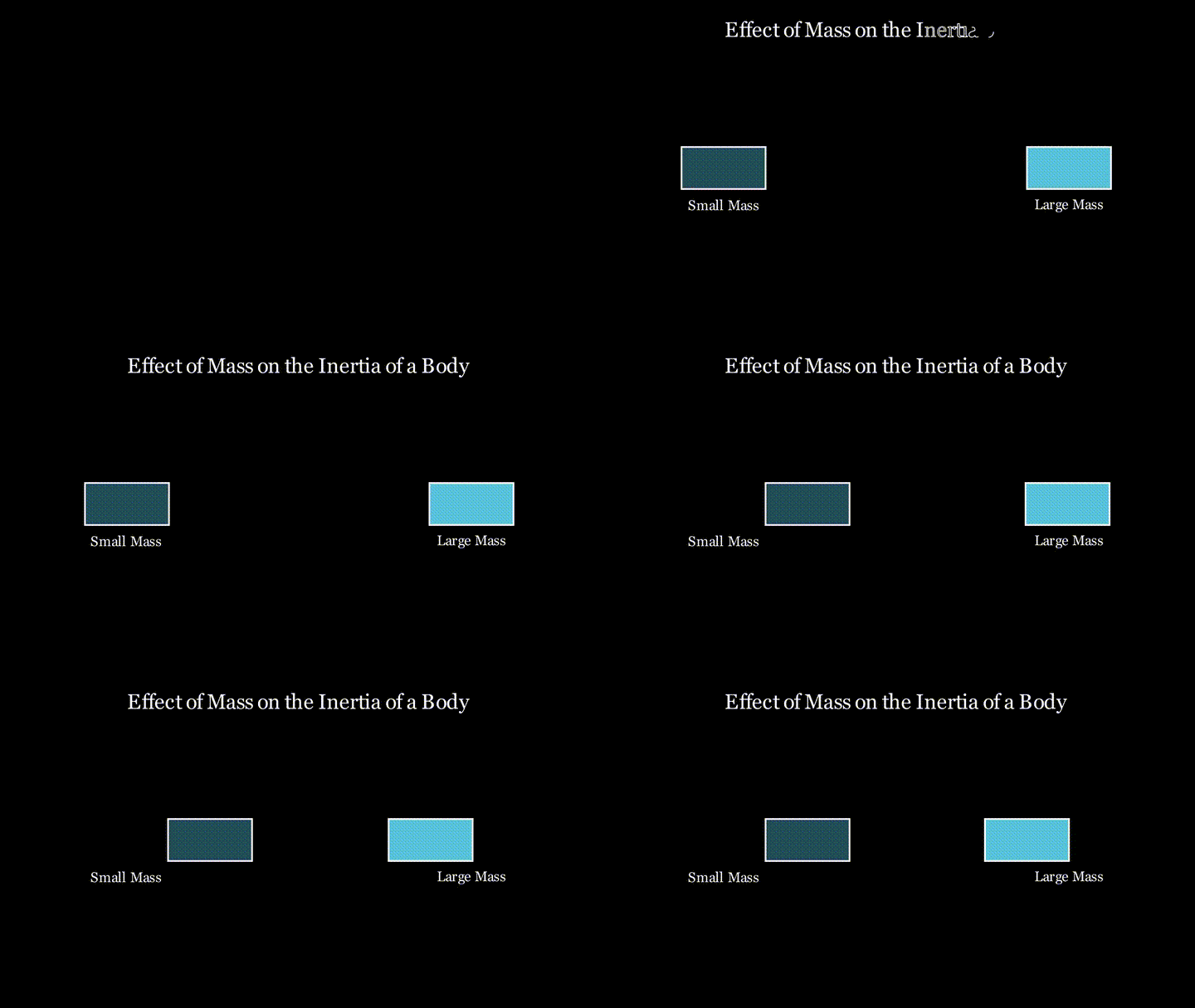
In rotation the same idea appears in a different guise: the body resists a change in angular velocity, that is, resists being spun up or brought to a halt. The quantity that plays the role of mass here is the moment of inertia. If mass says how stubborn a body is about changing its straight-line motion, the moment of inertia says how stubborn it is about changing its spin.
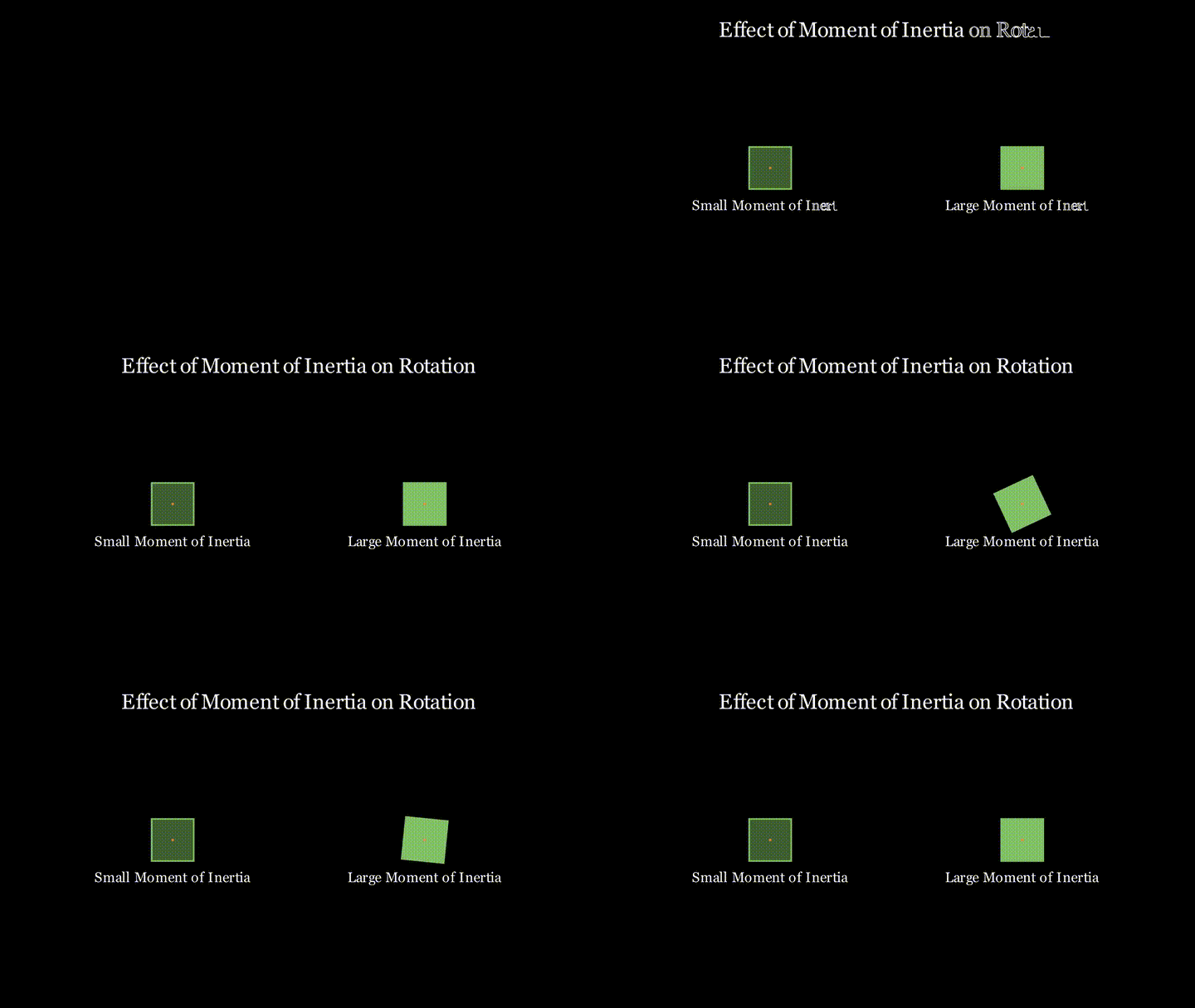
When a body rotates, every point in it travels along a circle of its own radius about the axis. Each point contributes to the total resistance according to its mass and to how far it sits from the axis — the farther out, the larger the contribution, because at a larger radius the same angular acceleration demands a larger torque.
The general formula
For a mechanical system made of many point masses, the moment of inertia is a sum:
where:
- Jₐ — the moment of inertia about the axis a
- mᵢ — the mass of the i-th point
- rᵢ — the distance from the i-th point to the axis
For a continuous body the sum becomes an integral of the squared distance to the axis over the infinitesimal masses dm:
For a single point mass the expression collapses to the familiar formula:
Writing dm through density and a volume element, dm = ρ dV, gives:
where:
- ρ — the density of the material
- dV — a volume element of the body
- r — the distance from the element dV to the axis a
If the body is homogeneous, the density comes out of the integral:
The second moment of area
In strength of materials the quantity actually needed is usually not the mass moment of inertia but the second moment of area of the cross-section: the mass element dm is replaced by an area element dA. That is exactly what the calculator on the home page evaluates — about the x and y axes, along with the polar moment Ip = Ix + Iy.