Moment of inertia of a rectangle: deriving Ix = bh³/12
3 min read · Updated
The moment of inertia of a rectangular section
The moment of inertia is one of the key properties of a cross-section: it describes how the area is distributed about a chosen axis. For a rectangle — the most common shape in engineering calculations — the formula is easy to derive analytically, yet it rests on a fundamental integral definition.
The definition
For a plane figure the second moments of area about the x and y axes are defined as area integrals:
Here:
- A — the area of the figure
- x, y — the coordinates of a point inside that area
- Ix — the moment of inertia about the x axis
- Iy — the moment of inertia about the y axis
Setting up the problem
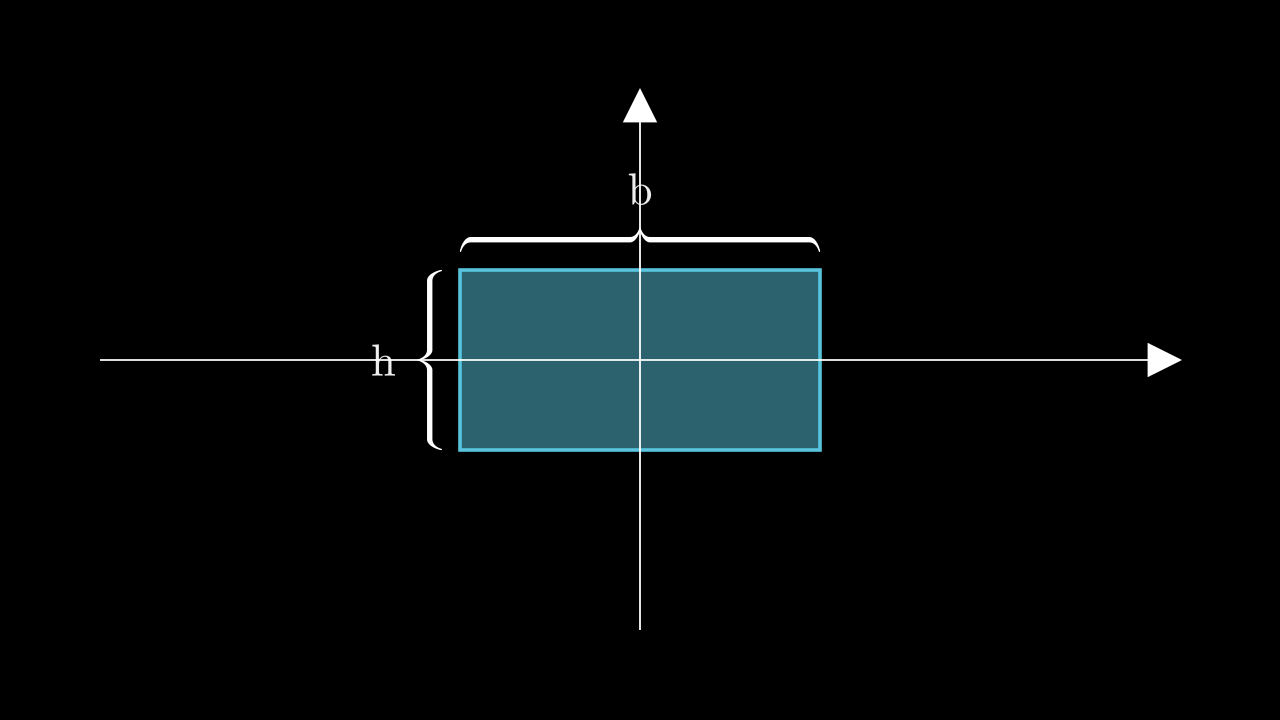
Take a rectangle of width b and height h placed symmetrically about the origin: its centre is at (0, 0) and its sides are parallel to the axes. The integration limits are then x from −b/2 to b/2 and y from −h/2 to h/2.
Deriving Ix
First evaluate the inner integral over y:
Then integrate over x, where the integrand no longer depends on x:
Deriving Iy
The argument is perfectly symmetric: the square is now taken of the x coordinate, so the width enters as a cube.
What the result means
The formulas show that Ix leans on the height h, which is cubed, while Iy leans on the width b. That matches the intuition: the farther the area lies from an axis, the harder the figure is to rotate about it. A tall, narrow section therefore has a large moment of inertia about the horizontal axis and a small one about the vertical — which is exactly why a joist is installed on edge.
Where it is used
- mechanics — resistance to bending and torsion
- structural engineering — beams, trusses, bridges
- machine design — shafts, frames, brackets
- simulation — rigid body behaviour in physics engines
For arbitrary shapes the moment of inertia is computed numerically: the outline is split into triangles and their contributions are summed — the approach used by CAD and FEM packages, and by the calculator on this site. For simple shapes such as a rectangle, though, the closed-form result is instant and exact.